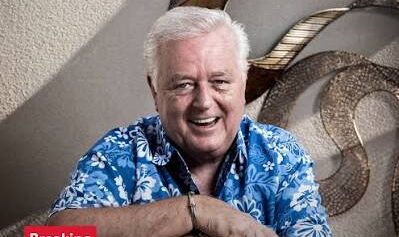
Australian singer, songwriter, television host and entertainment pioneer Johnny Young has died at the age of 79 following a brief battle with pancreatic cancer, his family has confirmed.
Young was one of the most recognizable figures in Australian popular entertainment, building a career that stretched across music, television, songwriting, production and broadcasting. His death has prompted an outpouring of tributes from performers, politicians, colleagues and generations of Australians who grew up watching his programs.
Born Johnny Benjamin Arthur de Jong in Rotterdam in 1947, Young moved with his family to Australia as a child and was raised in Western Australia. He entered the entertainment industry as a teenager and first gained national attention as a pop singer.
His breakthrough came in 1966, when Step Back became a major Australian hit and reached No. 1 on the national charts. He also enjoyed success with songs including All My Loving, establishing himself as a recording artist before his television career became his defining contribution to Australian entertainment.
Young’s career expanded rapidly during the 1960s. He worked as a singer, songwriter, producer and television personality, eventually becoming one of the country’s most familiar television faces.
He is best remembered for creating, producing and hosting Young Talent Time, the hugely popular television variety program that ran from 1971 to 1988. The show became a major part of Australian family television and provided an important platform for young performers.
Among the performers whose careers were helped by the program were Tina Arena, Dannii Minogue and Debra Byrne. For many young Australians hoping to enter the entertainment industry, appearing on Young Talent Time represented an important opportunity to perform before a national audience.
Young’s influence was not limited to television. He was also an accomplished songwriter who wrote or produced songs that became significant parts of Australian pop culture. One of his most notable songwriting achievements was “The Real Thing,” recorded by Russell Morris and later regarded as one of Australia’s iconic popular songs.
His contribution to Australian entertainment was formally recognized over the years. Young was inducted into the TV Week Logie Hall of Fame and later entered the ARIA Hall of Fame in 2010, cementing his status as one of the country’s influential entertainment figures.
Tributes following his death have highlighted not only Young’s professional accomplishments but also the role he played as a mentor to younger performers.
Tina Arena, whose career was closely connected to Young Talent Time, has previously spoken about Young’s influence on her life and career. His ability to encourage and nurture young performers became an important part of his legacy.
Prime Minister Anthony Albanese also paid tribute following news of Young’s death, describing the entertainer as someone who brought joy to Australians and helped introduce a new generation of performers to the country.
Young’s family confirmed that he had been battling pancreatic cancer and has asked for privacy while grieving. Details of a memorial service are expected to be announced later.
He is survived by his wife, Marisha, daughters Anna and Fleur, grandchildren and great-grandchildren. His son Craig died in 2014 after also battling pancreatic cancer.
For generations of Australians, Johnny Young was more than a television presenter. He was a familiar presence in living rooms, a successful recording artist, a songwriter, a producer and a mentor who helped young performers find their voices.
His death marks the end of a career spanning more than six decades and the loss of one of the figures who helped shape Australian music and television. His influence will continue through the artists he encouraged, the songs he created and the enduring memories of Young Talent Time.